Accessible clean water for recreation refers to places where people can safely swim, wade, paddle, play, or cool down in water. These places can include water-play parks, splash pads, public pools, rivers, ponds, lakes, beaches, and ocean pools.
Clean water for recreation is especially important on hot days. It gives people a way to cool their bodies, spend time with others, exercise, and enjoy public space. In low-humidity conditions, water features can also help reduce local peak temperatures by several degrees. Human-made water-play spaces are especially important in places such as Western Sydney, where many neighbourhoods are far from the ocean.
Water-play features in parks can give young children a safer way to cool off. However, water spaces need careful design and management. The water must be clean, surfaces must not become slippery, and people need safe ways to enter, move through, and leave the space.
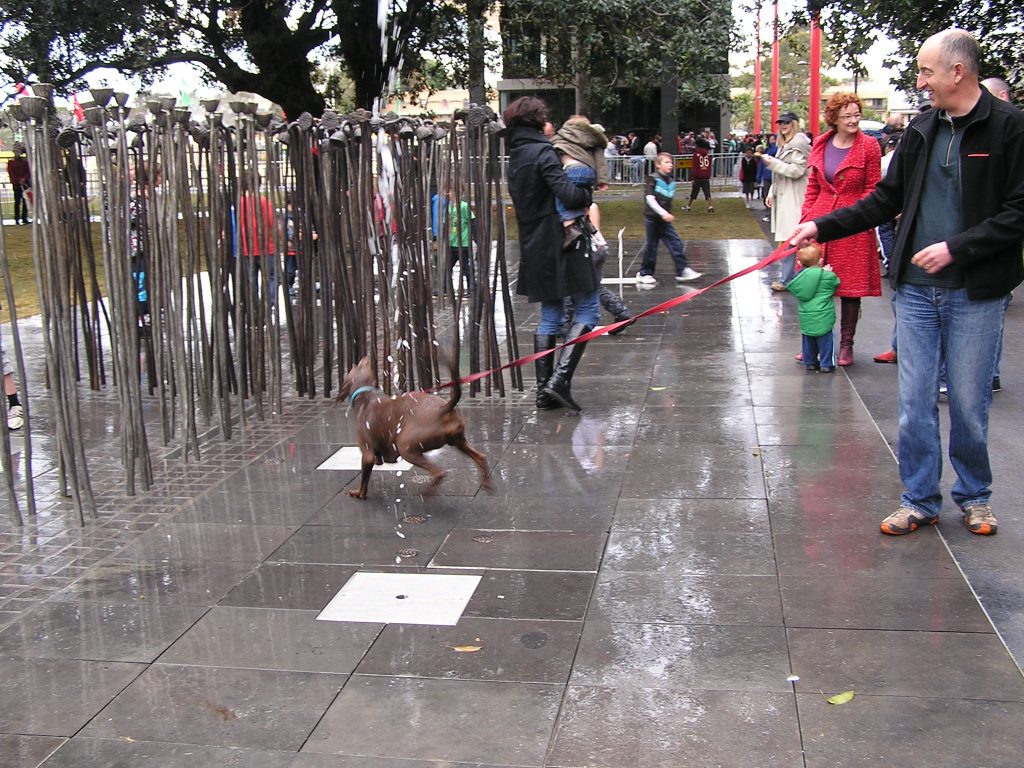
An example of this pattern is the water-play feature at Redfern, which provides a designed space for children and families to cool down through play.
Image caption: Water-play feature at Redfern. Photo: Research Team.
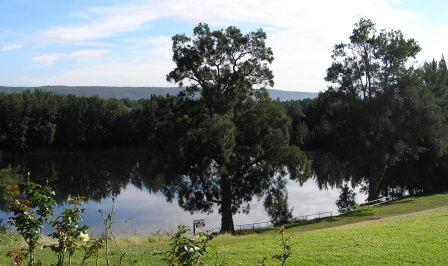
Another example is Penrith Beach along the Nepean River. Opened in 2023, Penrith Beach is a human-made swimming and recreation facility for residents of Western Sydney. It provides a place to cool off, but it also requires ongoing government monitoring of safety, access, and water quality. Water-play spaces should meet the NSW Everyone Can Play guideline.
Image caption: Penrith Beach along the Nepean. Photo: Research Team.
Making clean water for recreation accessible: some considerations
Access: who can use this commons?
Access should be as wide as possible for people with different needs, abilities, ages, and cultural practices. Clean water for recreation should be easy to find, easy to reach, and easy to use.
Important access questions include: Can people get there by walking, cycling, public transport, or community transport? Are paths, ramps, pool entries, river edges, or beach access points designed for people with mobility or sensory impairment? Are surfaces slip-resistant and free from trip hazards? Are children, older people, carers, and people with disability able to use the space safely? Are animals allowed? Is information about access, water quality, opening hours, and safety easy to find?
Use: what activities are preferred, and who manages them?
People use clean water for recreation in different ways. These include swimming, wading, paddling, boating, playing, exercising, relaxing, and gathering with others. Different activities require different levels of water quality, supervision, access, and safety. For example, water used for diving or swimming needs to be cleaner than water used for kayaking or boating. Areas of deep water also need different rules from shallow splash pads or fountains.
All water recreation commons need clear rules of use. These rules may be set by local councils, state government agencies, facility managers, or other land and water owners. In some cases, regular users, local residents, First Nations custodians, community groups, or environmental organisations may also help develop and maintain shared guidelines.
Rules should explain what activities are allowed, where they can happen, when the space can be used, and how different users can share the space safely. They should also explain how people can help keep the water and surrounding area clean.
Benefit: who benefits from using the space?
Clean water for recreation can benefit many people. It supports cooling, exercise, play, social connection, intergenerational gathering, and connection to place. It can also improve social cohesion by giving people a shared public place to enjoy during hot weather.
Natural waterways that are cared for as recreation spaces may also benefit plants, animals, and broader ecosystems. However, human access can also place pressure on fragile riverbanks, wetlands, dunes, habitats, and species. For this reason, recreational use needs to be balanced with ecological care.
Campaigns such as the push for a swimmable Birrarung/Yarra River show how making waterways safe for people can align with wider efforts to care for urban rivers and their ecologies.
Care: who cleans, repairs, or maintains the space?
Clean water for recreation needs ongoing care. Designed water-play spaces, pools, beaches, rivers, and ponds all require monitoring for risks to human health, including pollution, algae, toxins, pathogens, or contamination after rain. Natural water spaces may also need monitoring for fallen branches, rocks, unstable banks, currents, or other hazards. The NHMRC guidelines provide guidance on managing risks in recreational water.
Care may include water testing, cleaning, rubbish removal, repairing surfaces, maintaining toilets and change areas, checking access points, providing shade, and updating signs. Lifeguards, rangers, council workers, water safety staff, and community volunteers may all contribute to care. Users also have responsibilities, such as following safety advice, supervising children, avoiding polluted water, and leaving the space clean.
Responsibility: who sets the rules and ensures people are safe?
Legal responsibility usually sits with the owner or manager of the water space. This might be a homeowner with a private pool, a local council managing a public pool or water-play park, a state government agency managing a beach or river access point, or another public authority.
These owners or managers are responsible for monitoring safety and water quality, restricting access when needed, and communicating risks clearly. However, responsibility is also shared with users, who need to follow rules, care for others, and respond to changing conditions.
Ownership: who owns the land, water, or facility?
Ownership depends on the type of water space. A public pool or splash pad may be owned by local government. A river, lake, or beach may involve several forms of ownership, management, and custodianship across local, state, or federal agencies. Some waterways also sit within Country and require recognition of First Nations custodianship, knowledge, and responsibilities.
Because water spaces often cross property, ecological, and governance boundaries, ownership should be clearly explained. Users should know who manages the space, who monitors water quality, who maintains facilities, and who to contact if there is a safety or access issue.
Resourcing the Commons
Clean water recreation spaces may need safe entry points, slip-resistant surfaces, shade, toilets, change areas, seating, drinking water, bins, clear signage, accessible paths, and good public transport connections. They also need safety resources such as lifeguards or water safety staff where appropriate, first aid equipment, rescue equipment, emergency communication systems, and regular monitoring of water quality, pollution, algae, and post-rain contamination. Sun safety should also be planned for through shade, protective clothing, sunscreen, and warnings about high-risk times of day.
About this pattern
About this pattern
Accessible clean water for recreation refers to places where people can safely swim, wade, paddle, play, or cool down in water. These places can include water-play parks, splash pads, public pools, rivers, ponds, lakes, beaches, and ocean pools.
Clean water for recreation is especially important on hot days. It gives people a way to cool their bodies, spend time with others, exercise, and enjoy public space. In low-humidity conditions, water features can also help reduce local peak temperatures by several degrees. Human-made water-play spaces are especially important in places such as Western Sydney, where many neighbourhoods are far from the ocean.
Water-play features in parks can give young children a safer way to cool off. However, water spaces need careful design and management. The water must be clean, surfaces must not become slippery, and people need safe ways to enter, move through, and leave the space.
An example of this pattern is the water-play feature at Redfern, which provides a designed space for children and families to cool down through play.
Water-play feature at Redfern. Photo: Research Team
Another example is Penrith Beach along the Nepean River. Opened in 2023, Penrith Beach is a human-made swimming and recreation facility for residents of Western Sydney. It provides a place to cool off, but it also requires ongoing government monitoring of safety, access, and water quality. Water-play spaces should meet the NSW Everyone Can Play guideline.
Penrith Beach along the Nepean. Photo: Research Team
Accessible Water is an addition to swimming pools and Water Sensitive Urban Design (WSUD) features that are important for retaining water in the environment. Measure of success for these public spaces include maintaining full accessibility and operational up-time, and also maximising attendance.
In addition to WSUD features, making the most of access to existing natural assets is another important means by which neighbourhoods can benefit from coolth. In particular, still water bodies such as lakes, ponds and pools provide opportunities for people to relax and cool down by padding or swimming. Ideally public water bodies will be most easily accessible from the shallow end.*
Still water provides opportunities for the community to relax around the water edge, for instance, stairs can provide seating for water places that have a slope. Seating also allows for natural surveillance, which aids safety.
Pattern Conditions
Enablers
Strong community support for accessible water across different delivery modes.
Cooling and liveability city plans (e.g. Penrith City Council, 2015; Parramatta Ways Walking Strategy, 2017) and academic research (Mellick Lopes et al 2016; Mellick Lopes et al 2019) signal accessible water as a key consideration to enhance community cooling, participation in the commons, and urban walkability.
Availability of a natural water area such as a lake, pond or river that can be retrofitted for public use.
Artificial features such as ponds can be adapted for access if they have shallow access points and slip resistant surfaces. Pond surrounds can often be easily adapted for safe use.
Constraints
Drought conditions may limit water for play. Usability and toxicity of still water needs to be assessed and meet safety guidelines.
Material and finishes selection must consider slip and trip hazards.
Risks of ultraviolet radiation and sunburns if shade is not available will need to be actively managed by those responsible for the common.
Opening hours of most parks and water play areas currently limit evening use.
The community may have varying degrees of comfort with delineating human, animal or shared use of the common.
Still water quality must be suitable for public access. Some water bodies become more polluted following rain. This should be signposted to ensure safe access and use.
Commoning Concerns
Access
Designing for equitable access is an important consideration and should apply Universal Design Principles wherever possible. Decisions will need to be made around the shared access with animals.
Use
When the common is typically enabled by the land or asset owner for improved amenity, its use would not need to be negotiated by the community. In some instances, in the case of still water reserves for instance, swimming, paddling, resting and socialising with friends and family might be negotiated with communities involved.
Benefit
All residents, visitors, birds and animals benefit. Space can be provided for wildlife; a place for the community to paddle, swim and cool down.
Care
Shared between asset owner (i.e. maintenance, repair) and commoning community (monitoring and some day to day care and maintenance related to still water resources). Local Bushcare groups can play a vital role in some bushland water bodies.
Responsibility
While the asset owner would have a legal responsibility, the commoning community would be required accept the risks associated with the use of the potentially dangerous common.
Ownership
Local government; National Parks and Wildlife Service. The systems which ensure the safe operation of the infrastructure, along with the asset itself is typically owned by a local council. A commoning concern will be tolerance for shared use, human and animal.
References
NSW Department of Planning, Industry and Environment. Places to Swim: A Best Practice Guide to Get In, On, and Around Water in NSW (Draft). 2023.
National Health and Medical Research Council (NHMRC). Guidelines for Managing Risks in Recreational Water. Canberra: NHMRC; 2008. ISBN 1864962666 (print), 1864962720 (online).